

Bonjour, dear reader
Can I remind you of something? No? Okay, I know everyone’s constantly on the lookout for something new, so reminders are terribly unsexy. But lately I have been witnessing a strange phenomenon: everything that moved me forward in business and life was not a new insight, but something I had known for years and just finally put into practice. Hell, it’s all things that people have known for decades and centuries. Or something your mom already told you when you were five. Like: Stop lying! But since this is a sort of business newsletter, not a moral essay, here’s what you can expect:
WHY I believe this is the most pressing topic no one likes to talk about
HOW you can use honesty to gain trust and like yourself more
5 concrete steps to implement honesty in your customer acquisition engine
Let’s make things simple.
WHY I believe this is the most pressing topic no one likes to talk about
I have a database in Notion where I track ideas for topics I want to write about. When it’s time to write something, I look at my database and pick whatever feels right at the moment. This article is different, because the idea for it came to me literally today, when a couple of random pieces started to form a picture:
I signed up for my first coaching program
I had been chatting back and forth with Matt Wheeler-Barrett over the last couple of weeks, and he asked me if I wanted to join his coaching program. And I said yes. This is unusual for me, because normally coaching offers are to me what garlic is to vampires. So what was different this time? In short, I simply had the feeling that Matt was not lying to me. Crazy, right? (Check him out on Substack and LinkedIn. He is really different. In a good way.)
I watched a Hormozi podcast that touched on the same issue
The episode is called “Why trust is a bad bet,” and Alex talks about something I have been feeling for a while now, but could never really articulate. A lot of the mechanisms that created trust in the past now feel like gimmicks to me. At first I thought I’m just getting more cynical, but I increasingly get the impression that I am not the only one.
I felt a shift in a meeting with a consulting client
On Monday I had a face-to-face sit-down with a consulting client for a Strategy Deep Dive. We were talking about their positioning and why their offer matters to their customers. They are a fantastic company doing process digitalization and improvement for mid-market businesses. I pointed out that inefficient processes are probably going to hurt their customers more and more over time, because AI is advancing productivity so fast. One of the two founders looked at me and asked, “Ah, so you mean marketing by fear?” The way he said it, and the expression on his face, clearly showed he was not happy with it. Interestingly enough, he didn’t object, so I asked about it. It turns out that he and his co-founder both believe making processes better and digital is a great idea for all of their customers, but that most of them don’t need AI for that. And telling them their business will break if they don’t act now is simply not true. So we steered away from that idea toward a more positive message, and immediately the tension was resolved. And to go a step further: we’re now playing with the thought of making this positive message a key part of their positioning.
I buy something for the first time because I feel someone is honest.
Trust signals that used to work are eroding
Business owners of high integrity are wrestling with the question of whether their core beliefs can actually help them win more customers.
The whole topic involves admitting that we are part of the problem, which makes it uncomfortable and anti-viral. So probably important.
Wait, you want to lecture me? How dare you, I don’t even know who you are! Fair point. My name is Lorenz. I’m the founder of sales_essentially. Of the few things in life I know decently well, sales is one of them, because I have been doing this for 13 years, and along the way I helped grow a company from €300K in annual revenue to a €75M valuation. And I believe wholeheartedly that once you understand a topic, you realize it’s not that complicated. Cooking, exercise, taxes... you name it. There’s a lot of confusion about sales because people make money off the belief that selling is complicated. It’s not. If you want to grow your business beyond word-of-mouth, you need to turn strangers into customers reliably. I write about how you can do this as a small business owner without a brigade of resources.
WHAT makes lying in customer acquisition so tempting
To sell anything, you need to convince a prospective customer of two things: that your approach to solving his problem can work, and that he can trust you to actually deliver. What many business owners struggle with is the second part. This is because trust is not something you can create on a piece of paper. It’s typically the result of reputation.
You trust that your McDonald’s cheeseburger will taste the way you expect because you have already had a hundred of them in your life.
You trust that your new iPhone is worth the price because you already experienced the old model.
You trust that switching to a Google Pixel is a good idea because your friend recommended it and because you like other Google products.
No need for more examples, you get what I mean. As a small business owner, you often don’t have any of those things that create trust. What to do?
One obvious option is to start making things up. Maybe only a little bit. Or maybe full scale. Who cares anyway, this is only to get the customer, you know you can deliver, right? No harm done, right?
This might sound cynical, but I actually empathize. I struggle with the same questions, and it’s not like I’ve arrived at a morally clean answer. Especially if enough people are choosing this path, you feel like you have to do it too. It’s like being the only drug-free cyclist at the Tour de France, coming in dead last. If everyone is lying to gain the trust of their customers, you have every right to do the same. And so does the next guy.
And then you end up with LinkedIn.
HOW you can use honesty to gain trust and like yourself more
Ironically, buried in this conundrum is already your way out, and your edge! This works if you accept this one thought: you are not smarter than most other people. You know that you are being lied to, and they know it too. Maybe not everyone, but enough people to build a customer base on! There is a tribe for everyone, so if you don’t like lying, why not try to find people who dislike it too? And the crazy part might be that this is currently the road less traveled.
If you hit me up today with a LinkedIn InMail that sounds like this:
“Hey Lorenz, I went through my Sales Nav lead list today, and just from a 30-second glance it looks like you could be interested in what I do. Hard to say exactly, but I want to give it a try, you need to start somewhere. I saw that you run your business as a solopreneur and that you are married (you mentioned your wife in a post once). A lot of people like you hustle so hard in their business that they start neglecting their partner. I help as a virtual assistant. I use AI to make my work economically viable, and it’s still not cheap, but I believe I can really make lives better. I just started the business last month and I’m looking for my first customer. On the one hand I lack experience, but on the other hand I can promise you that I will move mountains to make you so happy that you recommend me to your friends! If this sounds interesting, let me know!”
I would buy from you with a smile.
My point is that in an age of lying, it’s the honest admission of not being perfect that creates trust now.
5 concrete steps to implement honesty in your customer acquisition engine
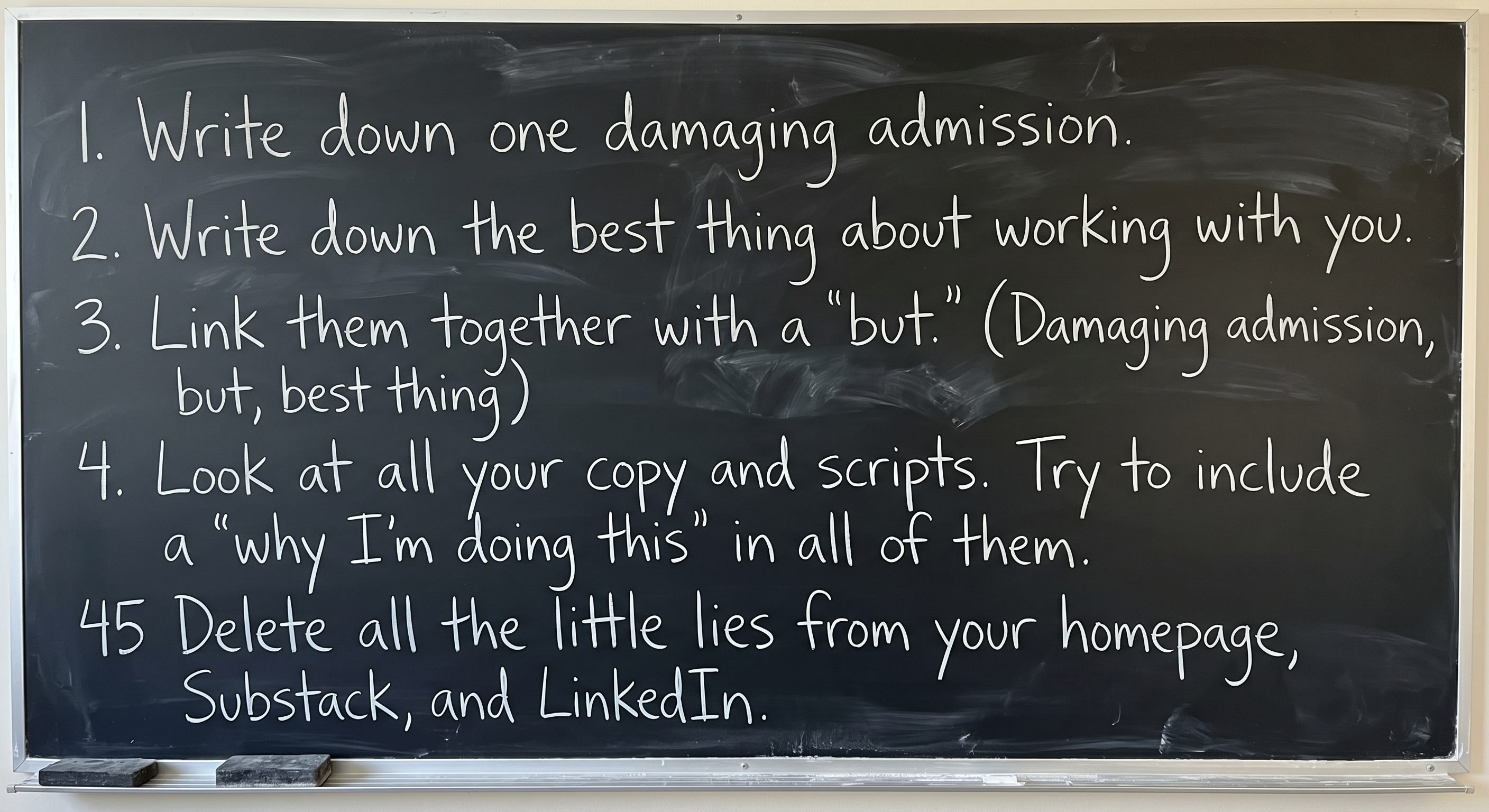
Write down one damaging admission. Something about you or your business that is a real downside to working with you.
Write down the best thing about working with you.
Link them together with a “but.” Damaging admission, but, best thing about you. Be real about it (no “I’m too much of a perfectionist” bullshit). Like: “Our pricing model is complex, and you will need 10 minutes to understand everything. But it is extremely fair. You will never pay for a service you didn’t use.”
Look at all your copy and scripts. Try to include a “why I’m doing this” in all of them. The honest reason you’re doing it. Example: “I’m sending you this sample because a certain percentage of people who use it like it so much that they then want to work with me. The ones who don’t (the majority, unfortunately) still appreciate the tester, which helps my reputation long-term.”
Delete all the little lies from your homepage, Substack, and LinkedIn. At least give it a try for a month and see if it changes anything in a negative direction. I bet you it won’t.
I hope that helped.
Lorenz
P.S. When I worked on my copy and scripts with Claude, it constantly wanted to nudge me into lying. I helped grow a business from €300,000 ARR to a €75M valuation. Every time Claude came back with a “tightened” version, it had changed it to: “I grew a company from €300,000 to a €75 million exit.” I don’t know about you, but this tells me something about the state of “proof” stories.
P.P.S. There’s a pretty cool quote from Jordan Peterson: “If you tell the truth, and nothing else, you’ll have an immense adventure as a consequence.”
Looking forward to working with you!