
Customer Acquisition Strategy in Three Questions
It sounds like it needs a degree. It needs three questions.

“Customer acquisition strategy” is one of those terms that sounds like it needs a degree.
It doesn’t. It needs three questions.
If you run a business, you need customers. And if you need customers, sooner or later someone will tell you to build a customer acquisition strategy. Usually that someone charges a lot of money to explain what it is.
So let me take it apart, put it back together in plain English, and leave you with three questions you can answer this afternoon.
What the words actually mean
Start with the two halves.
Strategy means deciding what you do and what you don’t do. You have finite time, finite attention, finite money. You can’t chase every option. Strategy is the act of picking. Everything else is wishful thinking.
Customer acquisition is two things. Getting people interested in what you sell. And getting them to pay for it.
Put the halves back together and you get this:
The choices you make about how to get people interested in what you sell and how to get them to pay.
That’s it. No more, no less.
The three steps every customer goes through
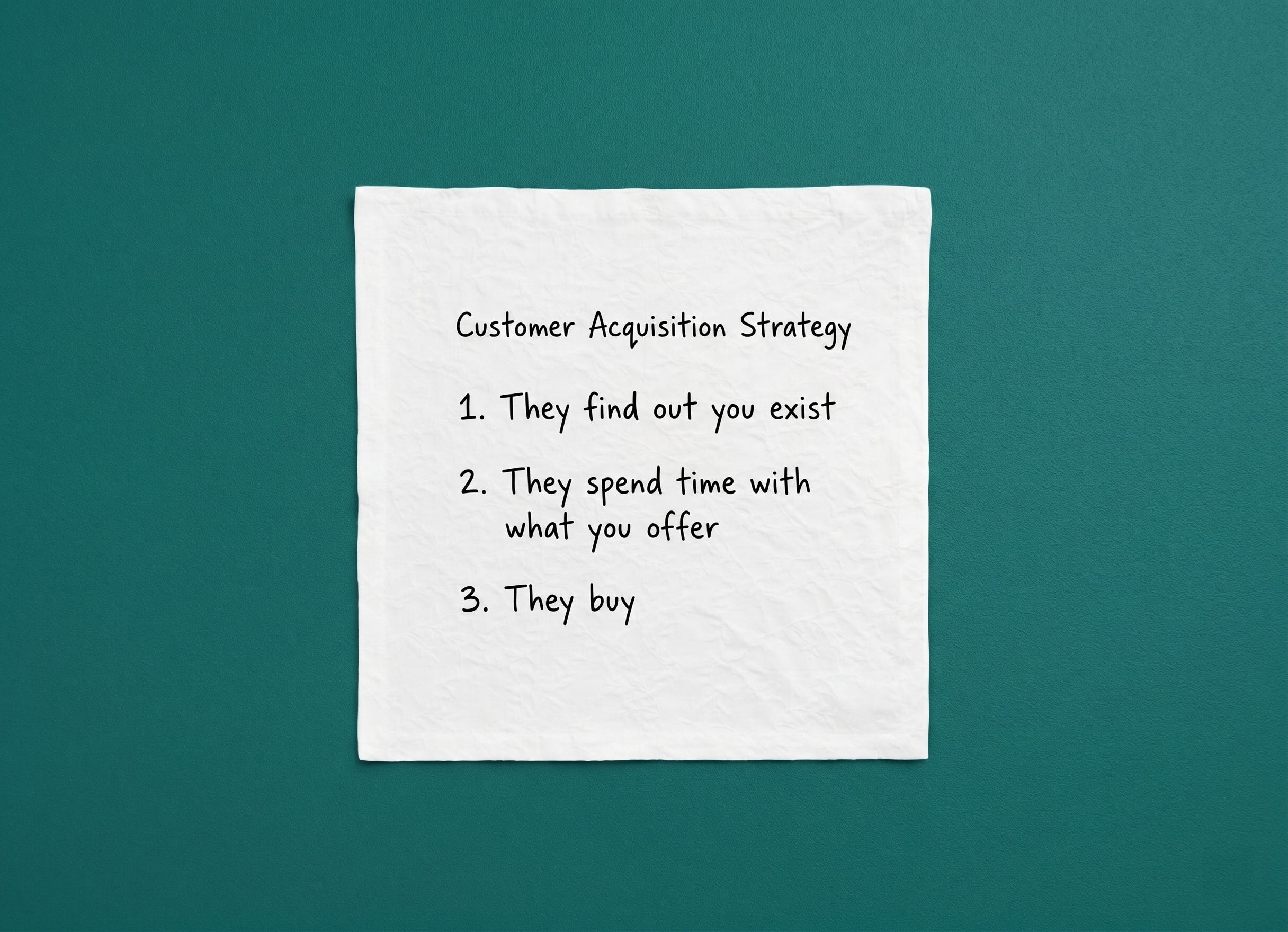
No matter what you sell, a customer goes through exactly three steps before they pay you.
1. They find out you exist
2. They spend time with what you offer
3. They buy
Every tactic, every tool, every channel fits into one of those three buckets. If you understand the buckets, you understand customer acquisition.
Your tools are your offers
Your tools are three offers.
1. A free resource that gets someone interested. A guide, a checklist, a short video, a survey. Something valuable enough that a stranger is willing to give you their email for it. This is also called a Lead Magnet.
2. Your main offer, the core of your business. The thing people actually pay you for. I call this your Foundation Offer.
3. Optionally, a smaller entry offer. A lower-risk version of your main offer that lets someone experience you before committing to the full thing. You only need this if your main offer is hard to sell cold. I call it a Door Offer (because it gets your customers through the door. I know, so creative.)
That’s your whole toolbox. Three things.
The three questions
Now everything collapses into three questions.
1. What do you promote?
The free resource or the main offer. Pick one, not both at the same time. Different messages need different audiences, and splitting yourself dilutes both.
2. How do you promote it?
The channel. There are only four channels that matter. I borrowed them from Alex Hormozi and I keep coming back to them because they cover everything.
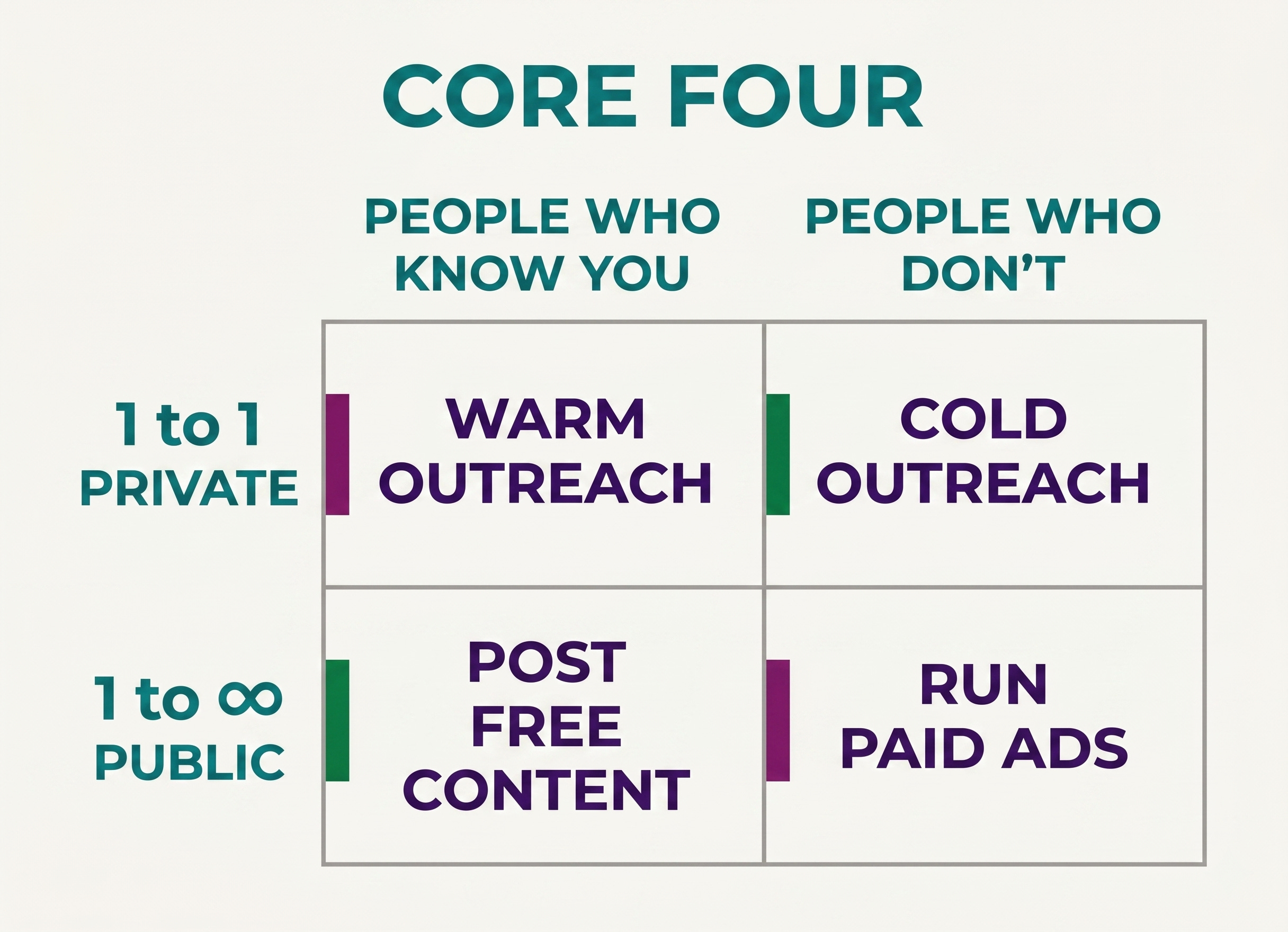
• Warm outreach (private, people who know you)
• Cold outreach (private, people who don’t)
• Post free content (public, people who know you)
• Run paid ads (public, people who don’t)
Every way of getting customers fits into one of those four. Pick the one that matches your strengths and the person you’re trying to reach. Not the one that is trending.
3. Who do you promote it to?
Your avatar. The specific person you are trying to reach. The clearer the person, the sharper the free resource, the sharper the main offer, the sharper the message.
How this looks in practice
A founder I work with runs a services business. Around €300,000 a year. Every customer he has came from referrals. No plan to get new ones.
I asked him three questions.
What do you promote? Blank look.
How do you promote it? Blank look.
Who do you promote it to? A little less blank, but still vague.
So we sat down for 45 minutes and answered them.
He chose a simple free resource. A short checklist his customers could fill out in 10 minutes. He chose one channel. Warm outreach, because his network is his best asset and his customer isn’t on TikTok. He chose his avatar. Mid-sized business owners in one specific industry. Not “entrepreneurs” in general.
Three answers. One strategy.
He walked out with something he could act on Monday morning. Not a perfect plan. Not a final plan. A starting plan. That is all you ever need.
Why this feels too simple
You might read this and think “that’s it?”
That’s it.
The reason it feels too simple is that you have been trained to believe it’s complicated. The moment someone gets to keep the mystery, they get to keep charging for it. There is a whole industry built on making this sound like rocket science. It isn’t.
You don’t need a framework with 17 layers. You need three answers.
What to do this afternoon
Print the three questions. Put them on your desk.
What do we promote?
How do we promote it?
Who do we promote it to?
Write down the answer for your own business. If the answer is “I don’t know,” that’s fine. That is the work. Narrow your avatar. Pick a free resource. Choose a channel.
When you have three clear answers, you have a customer acquisition strategy. The rest is execution.
It’s not rocket science. It’s three questions.
P.S. If you catch yourself writing a 40-slide strategy document instead of answering three questions, that is a sign you’re still playing the consultant’s game. Close the document. Answer the three questions. Move.